Human Rights Update: Case Closed
Controversial Charges against Australian Writer Dropped

IN NOVEMBER I posted, “What Do Thailand, Malaysia, and Steely Dan Have in Common?” highlighting an unusual criminal case against an Australian writer living in Thailand.
About ten years ago Murray Hunter, with whom I have become acquainted, moved to Southern Thailand across the border from Malaysia. He had previously worked as a university instructor during the many years he lived in that country.
For years, Hunter has been writing about Malaysia and other interests on Substack, although Malay authorities have blocked internet access to his Substack account within their borders. He has not shied away from being sharply critical at times. This apparently has made him a thorn in the side of Malaysian officials.
“Freedom of speech (is protected)—yes,” one of the lawyers representing Malaysia told Hunter. “But so is reputation.”
A state agency that regulates telecom in Malaysia, filed criminal charges last year against Hunter—in Thailand. Hunter had not minced words on the Malaysian agency’s censorship of the internet. The agency filed a criminal complaint in reference to some articles Hunter posted on Substack years ago, claiming they crossed the line from protected speech to illegal defamation.
Hunter has lived outside Malaysia for a decade. Still, he has remained on the authorities’ radar. They blocked his Substack account, where is allegedly defamatory articles appeared, from netizens’ access there.
The Malaysian regulatory agency in question stated their representative accessed the articles while inside Thailand. This complainant told police that Hunter’s articles were damaging to the agency’s reputation in violation of Thai law.
It surprised me—and other observers inside Thailand, including journalists, Thai lawyers, and human rights organizations—that Thai prosecutors chose to indict Hunter.
One would have expected a finding that a foreign state agency lacks standing in Thai court. Apparently, someone in the Thai Attorney General’s Office found Malaysia’s legal gymnastics regarding jurisdiction and criminal liability legally (or politically?) persuasive.
Prosecution across national boundaries to silence or harass dissidents, journalists, or other critics, called transnational repression, is considered a human rights violation. A common tactic to implement this repression is to pursue legal charges like those against Hunter in response to public criticism. This legal tactic is called filing a SLAPP: Strategic Lawsuit Against Public Participation.
SLAPP is an increasingly popular mechanism for powerful players with deep pockets—corporations or governments—to use the legal system as a weapon for retaliating against someone they see as a nuisance. Winning or losing in court is not crucial—it’s a scare tactic, dragging someone with limited resources into court, in which the legal process itself, more than the final ruling, is the punishment. The broader goal is to intimidate other would-be actors from becoming a nuisance: stifling free speech.
Hunter was arrested at the Bangkok airport this past October. He was on his way to Hong Kong for a vacation, but his name had been flagged. He was briefly jailed, criminal charges were pressed, hearings were scheduled, and Hunter’s passport confiscated by the Thai police.
One wonders what was going through the mind of the Thai judge when he received Hunter’s case file at his desk, reading the charge sheet. One also wonders what behind-the-scenes machinations may have been behind the Thai authorities’ decision to move forward with prosecution.
At any rate, a trial date was set. The non-profit legal team of Thai Lawyers for Human Rights offered Hunter their services pro bono, which he gladly accepted.
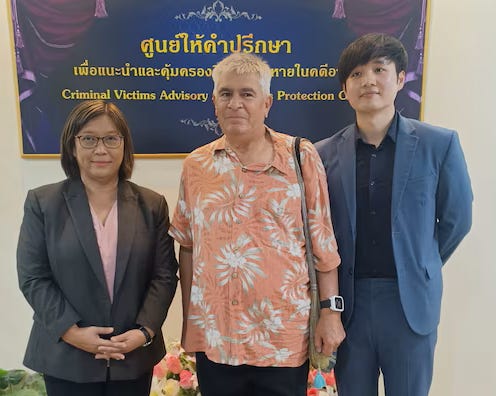
Murray Hunter with part of his legal team from Thai Lawyers for
Human Rights.
The assigned judge scheduled a mediation conference before the trial was set to begin. The aim was to explore the possibility of a settlement out of court. I attended the initial mediation conference as an observer. Identified as a friend of the defendant, my presence was allowed, as was that of his Thai fiancée. The Malaysian legal team rejected Hunters’ lawyers request for UN representatives to also observe.
Offers and counteroffers were proposed during the half-day session. (Details are protected from disclosure as a condition for mediation.) The attorneys of both sides agreed to schedule a follow-up meeting to further negotiate a final agreement. This would give the attorneys from Malaysia a chance to discuss the details with the state agency they were representing.
A second mediation conference was set for a few weeks later. It would be something of a marathon, lasting all day, as the details were hammered out. In the end, both parties agreed to the terms of a settlement.
The settlement was formalized yesterday by the Thai judge presiding in open court.
The outcome, as reported by the Associated Press:
All charges against Hunter have been dropped.
Hunter’s Substack has been unblocked in Malaysia.
He has expressed his regrets that his articles offended Malaysia’s internet regulatory agency.
Hunter retracted certain articles, deleting them from Substack.
This is the outcome one who cares about justice would hope for. Still, as discussed above, despite Hunter having had to pay no legal fines or fees, or facing up to 8 years in a Thai prison, the entire process against him was punitive.
He spent a brief time in jail after his airport arrest. He was subsequently required to attend multiple legal proceedings in Bangkok, about 1,000 kilometers from his home in Southern Thailand. He has been restricted from international travel (Thai authorities have still not returned his passport. Hunter expects this to be resolved soon, before his current visa expires).
In short, his life has been thoroughly and stressfully disrupted, turned upside down by a legal process triggered by questionable—if not flat-out bogus—charges. Enduring this upheaval, courtesy of a transnational SLAPP, was its own punishment, despite the legal charges being dropped.
And what about the rest of us? That is to say, other social critics who live in Thailand?
Is Thailand’s prosecution of Hunter a precedent? Does it reveal a willingness to engage in transnational repression as a new norm? Do Thai authorities embrace the subsequent chilling effect?
Or is someone in the hierarchy sensitive enough to the potential downside this could have for Thailand (as well as Malaysia) in terms of tourism, foreign trade and investment, and international relations? Did “invisible hands” move the settlement forward, and were lessons learned to distance Thailand from future cases of transnational repression?
We don’t know, but Hunter has some hope.
On December 19, before his case was settled, Hunter was invited to discuss his predicament with members of Thailand’s Parliament. Specifically, he appeared before the Senate Committee on Political Development, Public Participation, Human Rights, Liberties and Consumer Protection. The misuse of SLAPP tactics falls under this committee’s purview.
Hunter told me the senators in attendance were highly attentive, and he left with the sense that they would be advocating for a dismissal of his charges.
Now that his legal case is behind him, Murray has returned to writing on Substack. He believes that the Senate will begin a formal inquiry into his case.
Ideally, this could discourage Thai prosecutors from pursuing future cases of transnational repression.